Via Salaria, 430
Tel. +39 06 8620 6272
Official site
The Catacombs of Priscilla, located in Rome, Italy, are among the most significant and well-preserved early Christian burial sites, offering a unique glimpse into the religious, artistic, and cultural practices of early Christianity. Situated along the Via Salaria in the northern part of the city, these catacombs are renowned for their extensive network of underground galleries, early Christian frescoes, and historical significance. Below is an in-depth exploration of the Catacombs of Priscilla, covering their history, structure, art, significance, and modern context.
The Catacombs of Priscilla were established in the late 2nd century
AD and were used primarily between the 2nd and 5th centuries AD as a
burial place for Christians and, to a lesser extent, pagans and Jews.
Named after Priscilla, a member of the prominent Acilius family and
likely a benefactor or martyr, the catacombs were constructed on land
donated by her family. The site’s association with the Acilius family
underscores its importance, as they were a wealthy and influential Roman
family, some of whom converted to Christianity.
The catacombs served
as a place for burial, memorial services, and, during times of
persecution, secret worship. Unlike popular myths, catacombs were not
primarily hiding places for Christians but were sacred spaces for
interring the dead and honoring martyrs. The Catacombs of Priscilla are
particularly notable for their early Christian iconography, which
provides insight into the development of Christian theology and art.
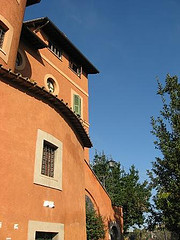
The Catacombs of Priscilla are located at Via Salaria 430, in a quiet
residential area of Rome. The site is managed by the Pontifical
Commission for Sacred Archaeology and is open to visitors under guided
tours. The catacombs are carved into the soft volcanic tuff beneath the
Villa Ada park, a common material for Roman catacombs due to its ease of
excavation and durability.
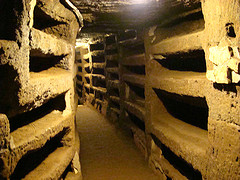
The structure of the Catacombs of
Priscilla is complex, spanning multiple levels and covering
approximately 13 kilometers (8 miles) of underground galleries, though
only a portion is accessible to the public. The layout includes:
Galleries: Narrow, tunnel-like corridors lined with loculi (rectangular
niches for bodies) carved into the walls. These loculi were sealed with
marble or terracotta slabs inscribed with names, prayers, or symbols.
Cubicula: Small chambers used for family burials or as chapels for
memorial services. These rooms often feature elaborate frescoes.
Arcosolia: Arched niches containing sarcophagi or larger tombs,
typically reserved for wealthier individuals or martyrs.
Basilica: A
small underground basilica, likely used for Eucharistic celebrations, is
a unique feature of these catacombs, reflecting their role as a place of
worship.
The catacombs were expanded over time, with deeper
levels added as the need for burial space grew. The site’s preservation
is remarkable, as it was less subject to looting compared to other
catacombs, allowing many frescoes and inscriptions to remain intact.
The Catacombs of Priscilla are often called the "Queen of the
Catacombs" (Regina Catacumbarum) due to the richness and quality of
their frescoes, which are among the earliest examples of Christian art.
These artworks, dating from the 2nd to 4th centuries, provide a visual
record of early Christian beliefs, including themes of salvation,
resurrection, and divine protection. Below are key artistic highlights:
Greek Chapel (Capella Greca)
The Greek Chapel, a two-room cubicula
named for Greek inscriptions found there, is one of the most significant
areas. It dates to the late 2nd or early 3rd century and features some
of the oldest Christian frescoes:
Banquet Scene: Often
interpreted as an early depiction of the Eucharist or an agape meal,
showing figures reclining at a table.
Fractio Panis: A famous fresco
depicting the "Breaking of the Bread," considered one of the earliest
representations of the Eucharistic celebration. Seven figures (possibly
including women) are shown at a table, with one breaking bread,
symbolizing the Last Supper or communal worship.
Old Testament
Scenes: Images of Noah’s Ark, Daniel in the Lions’ Den, and the Three
Hebrews in the Fiery Furnace, symbolizing divine deliverance and
salvation.
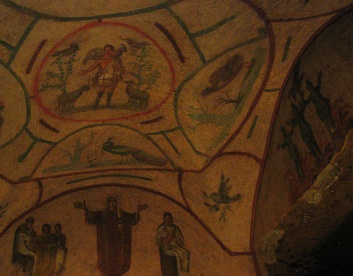
Cubiculum of the Velata
This chamber features the
"Orant" or praying figure, a woman with arms outstretched in a gesture
of prayer, symbolizing the soul’s supplication to God. The figure, often
identified as the deceased, is surrounded by scenes such as:
The
Good Shepherd: A central image of early Christian art, depicting Christ
as a youthful shepherd carrying a lamb, symbolizing care for the
faithful.
The Virgin Mary with Child: One of the earliest known
depictions of Mary holding the infant Jesus, dating to the mid-3rd
century. A figure, possibly a prophet (e.g., Balaam or Isaiah), points
to a star, symbolizing divine revelation.
Life Cycle Scenes: Frescoes
showing marriage, childbirth, and prayer, possibly representing the life
of the deceased woman.
Other Notable Frescoes
Jonah and the
Whale: A common motif symbolizing resurrection, as Jonah’s emergence
from the whale parallels Christ’s resurrection.
The Phoenix: A symbol
of immortality and resurrection, reflecting both Christian and pagan
influences.
Peacocks and Doves: Symbols of eternal life and the Holy
Spirit, respectively, often painted in vibrant colors.
Christ as the
Teacher: Depictions of Jesus teaching, emphasizing his role as a guide
for the faithful.
The frescoes use simple but expressive styles,
with vivid colors (reds, greens, yellows) and minimalistic designs
typical of early Christian art. They reflect a transition from pagan
Roman art to a distinctly Christian visual language, blending classical
motifs with new theological meanings.
The Catacombs of Priscilla hold immense historical, religious, and
artistic value:
Early Christian Theology: The frescoes and
inscriptions reveal core Christian beliefs, such as the resurrection,
salvation, and the Eucharist, at a time when Christianity was still
developing its identity under Roman persecution.
Role of Women: The
prominence of female figures in the art (e.g., the Velata and figures in
the Fractio Panis) suggests the significant role of women in early
Christian communities, possibly as deacons or patrons.
Archaeological
Insight: The catacombs provide evidence of burial practices, social
structures, and the integration of Christian and pagan traditions in
late antiquity.
Artistic Evolution: The frescoes mark a pivotal
moment in the development of Christian art, bridging Roman decorative
styles with emerging Christian symbolism.
The catacombs also
served as a pilgrimage site, particularly for venerating martyrs buried
there. While specific martyrs are not well-documented, the site’s
sanctity is evident in its use for worship and memorial.
Today, the Catacombs of Priscilla are maintained by the Vatican and
are open to the public through guided tours, typically lasting 30–40
minutes. Visitors enter through the cloister of the Benedictine Sisters
of Priscilla, who oversee the site. The catacombs are less crowded than
other Roman catacombs, such as those of San Callisto or San Sebastiano,
offering a more intimate experience.
Key visitor information:
Access: Guided tours are mandatory, available in multiple languages, and
must be booked in advance. Photography is generally prohibited to
preserve the frescoes.
Highlights for Visitors: The Greek Chapel,
Cubiculum of the Velata, and the underground basilica are focal points
of the tour.
Conservation: The catacombs underwent significant
restoration in the 2010s, including laser cleaning of frescoes, which
revealed previously obscured details. A digital archive of the artwork
is available through the Vatican’s online resources.
The
catacombs are a UNESCO World Heritage candidate, recognized for their
universal cultural and historical value. They attract scholars,
pilgrims, and tourists interested in early Christianity and Roman
archaeology.
The Catacombs of Priscilla stand as a testament to the resilience and
creativity of early Christian communities in Rome. Their art and
architecture reflect a period of transition, where Christianity adapted
Roman cultural forms to express its spiritual message. The site’s
preservation allows modern visitors to connect with the faith, artistry,
and lives of Christians from nearly two millennia ago.
For scholars,
the catacombs offer a wealth of material for studying early Christian
iconography, gender roles, and liturgical practices. For the faithful,
they remain a sacred space, evoking the memory of martyrs and the
enduring hope of resurrection.